Tuesday, July 16, 2013
The war that will not end
This article addresses a topic that is almost to awful to comprehend. I would not post it here except for the gravity of the lesson that I believe it teaches, which is that history has shown that in every society there are those that seek power and will use any means to obtain and retain it. They will kill and torture without limit. One can hardly believe that people would be capable of doing the things that are discussed in this piece but I wonder if we believe that we are immune from these things. Do we think it is impossible that leaders in our country would be willing to do these things if given the power? If we make the same choices that people in other countries did we will sadly get the same results. How will it happen? Perhaps by embracing torture, indiscriminate killing with no due process, and endless war in the name of the "war on terror".
Liberty does not erode in a day. Like sandcastles in the rising tide, it is broken down slowly and is given up by those who do not know the tale of history and the vital need to wrest power from the tyrants who masquerade as benevolent leaders. Liberty can only be preserved by a balance of power. Government is force and when government is given to one man liberty is in jeopardy.
The reason I feel so strongly is out of the frustration I feel when people show such apathy and a complaisant disregard for small choices that erode liberty, such as allowing a president to decide when and how to start wars and do decide who our enemies are or the utter lack of value placed on privacy, property, and individual rights. It is as though people believe that small choices have no consequences. Everything in history happens because of small choices though. Your voice, your opinion, your vote, your voice, and your resistance to the overreaching arm of government matters. You, the individual, are the only thing that makes a difference.
The natural progress of things is for Government to gain ground and for Liberty to yield.
--Thomas Jefferson


Liberty Requires Individual Rights
Some politicians advocate the notion that individual rights are subservient to needs of the "greater good" of society, in other words that community rights trump individual rights. What would this look like in practical terms? Policies and laws that restrict or eliminate private ownership (property rights), restricting civil liberties such as outlawing free speech in the name of hate crimes or restricting the rights of parents to teach their children what they want, restricting the amount of natural resources such as water, land, or fuel, and possibly forcing you to participate in community projects. Like so many socialist intentions, it sounds very noble but the reality is almost the opposite of what it promises. Without respect for individual rights we will never establish good in our community. Happiness requires individual rights, not community rights.
Wednesday, September 5, 2012
Red vs Blue is not the answer
The ideals that are laid out in both the Democratic and Republican 2012 platforms are laudable and in general I find them agreeable to my personal values. The philosophies laid out by each are things that would be hard to disagree with by any patriotic American:
"We see an America that outeducates, out-builds, and out-innovates the rest of the world"
"...in America, hard work should pay off, responsibility should be rewarded, and each one
of us should be able to go as far as our talent and drive take us."
"This is a land of opportunity. The American Dream is a dream of equal opportunity for all."
"This platform affirms that America has always been a place of grand dreams and even grander realities; and so it will be again, if we return government to its proper role...If we lift up the middle class"
"Reclaiming the economic security of the middle class is the challenge we must overcome today."
It would seem that both parties aspire to high ideals and have the best of intentions. But these statements are hard to quantify. What matters much more than intentions is results. If a strategy aims to make a better America but ends up diminishing productivity, freedom, and safety then it deserves to be abandoned, no matter how much we wanted it to succeed. The problem is that many people do not look at results but focus almost exclusively on intentions. We believe what politicians say they are going to do but turn a blind eye to what they actually do.
Unfortunately too many fallen into the trap of thinking that our political and economic issues can be solved by a contest of Red vs Blue. They fight and struggle within an artificial constraint, wholly believing that all philosophies, ethos, strategies, and plans fall neatly into either the bin marked Republican or the one marked Democratic. This is a war that cannot be won because the premise is wrong. Both sides are fighting straw men, or in other words, caricatures that they have created to represent what they believe their opponents espouse. Each side claims that their party represents the highest ideals of charity, kindness, and morality while the other side revels in selfishness, elitism, and reckless decisions.
The solution to this problem is for individuals to build a personal political philosophy that is based on enduring principles of good government rather than one derived from or defined entirely by one of the two political parties.
While there are many fundamental issues to grapple with, one of the most basic issues is the degree to which government should be empowered to move society. When we debate what government should or shouldn't do and the degree of regulation and federal governance that is appropriate, the question is really whether people will they do something on their on volition (within a presumed framework of basic laws and order) or whether they need to be explicitly forced to do it. It is a fundamental question of what we believe the nature of mankind to be. Does mankind deserve freedom or will they squander and abuse it? The uniqueness of government as a vehicle for social movement is that it is force.
“Government is not reason. It is not eloquence. Government is force; like fire it is a dangerous servant -- and a fearful master.”
—George Washington, 1797
Let us not naively believe that government is free from corruption and abuse anymore than any other agency. Human beings run corporations and they also run the government.
It is up to each person to answer the question of how much government mankind needs. Your opinion will be shaped by your religious and philosophical beliefs and can hardly be influenced by what I write but I can offer my opinion, which is that basic freedom is essential to happiness. In other words, the least amount of federal government possible is the best for society. The unfortunate trap that too many have fallen into is the notion that the federal government is best vehicle for affecting change. I believe that the proper role of the federal government is to protect life, liberty and property and to secure our nation. Frederic Bastiat purported that “Life, liberty, and property do not exist because men have made laws. On the contrary, it was the fact that life, liberty, and property existed beforehand that caused men to make laws in the first place.” Local governments are much better equipped to dictate policy, laws, and regulations and when they do the result is almost without exception better for society. No doubt our country faces some very challenging problems. Don't look to the federal government to solve all of them. I believe that there still exists a majority of people who have an innate desire to help the needy, to act with a sense of personal responsibility, to cooperate with others, and to solve problems, that we can solve many of our problems without the force of federal government. If I am wrong, and people must be forced to do good then we are surely doomed. If mankind "cannot be trusted with the government of himself. Can he, then, be trusted with the government of others? Or have we found angels in the forms of kings to govern him? Let history answer this question.” -Thomas Jefferson
"We see an America that outeducates, out-builds, and out-innovates the rest of the world"
"...in America, hard work should pay off, responsibility should be rewarded, and each one
of us should be able to go as far as our talent and drive take us."
"This is a land of opportunity. The American Dream is a dream of equal opportunity for all."
"This platform affirms that America has always been a place of grand dreams and even grander realities; and so it will be again, if we return government to its proper role...If we lift up the middle class"
"Reclaiming the economic security of the middle class is the challenge we must overcome today."
It would seem that both parties aspire to high ideals and have the best of intentions. But these statements are hard to quantify. What matters much more than intentions is results. If a strategy aims to make a better America but ends up diminishing productivity, freedom, and safety then it deserves to be abandoned, no matter how much we wanted it to succeed. The problem is that many people do not look at results but focus almost exclusively on intentions. We believe what politicians say they are going to do but turn a blind eye to what they actually do.
Unfortunately too many fallen into the trap of thinking that our political and economic issues can be solved by a contest of Red vs Blue. They fight and struggle within an artificial constraint, wholly believing that all philosophies, ethos, strategies, and plans fall neatly into either the bin marked Republican or the one marked Democratic. This is a war that cannot be won because the premise is wrong. Both sides are fighting straw men, or in other words, caricatures that they have created to represent what they believe their opponents espouse. Each side claims that their party represents the highest ideals of charity, kindness, and morality while the other side revels in selfishness, elitism, and reckless decisions.
The solution to this problem is for individuals to build a personal political philosophy that is based on enduring principles of good government rather than one derived from or defined entirely by one of the two political parties.
While there are many fundamental issues to grapple with, one of the most basic issues is the degree to which government should be empowered to move society. When we debate what government should or shouldn't do and the degree of regulation and federal governance that is appropriate, the question is really whether people will they do something on their on volition (within a presumed framework of basic laws and order) or whether they need to be explicitly forced to do it. It is a fundamental question of what we believe the nature of mankind to be. Does mankind deserve freedom or will they squander and abuse it? The uniqueness of government as a vehicle for social movement is that it is force.
“Government is not reason. It is not eloquence. Government is force; like fire it is a dangerous servant -- and a fearful master.”
—George Washington, 1797
Let us not naively believe that government is free from corruption and abuse anymore than any other agency. Human beings run corporations and they also run the government.
It is up to each person to answer the question of how much government mankind needs. Your opinion will be shaped by your religious and philosophical beliefs and can hardly be influenced by what I write but I can offer my opinion, which is that basic freedom is essential to happiness. In other words, the least amount of federal government possible is the best for society. The unfortunate trap that too many have fallen into is the notion that the federal government is best vehicle for affecting change. I believe that the proper role of the federal government is to protect life, liberty and property and to secure our nation. Frederic Bastiat purported that “Life, liberty, and property do not exist because men have made laws. On the contrary, it was the fact that life, liberty, and property existed beforehand that caused men to make laws in the first place.” Local governments are much better equipped to dictate policy, laws, and regulations and when they do the result is almost without exception better for society. No doubt our country faces some very challenging problems. Don't look to the federal government to solve all of them. I believe that there still exists a majority of people who have an innate desire to help the needy, to act with a sense of personal responsibility, to cooperate with others, and to solve problems, that we can solve many of our problems without the force of federal government. If I am wrong, and people must be forced to do good then we are surely doomed. If mankind "cannot be trusted with the government of himself. Can he, then, be trusted with the government of others? Or have we found angels in the forms of kings to govern him? Let history answer this question.” -Thomas Jefferson
Wednesday, April 25, 2012
Global Temperature Stability
Just for the record, I have never believed that global warming was true. As someone who works in the test and measurement industry I recognized that the science behind global warming was simply not there. For starters, it is impossible to measure the temperature of the entire globe to within 1/2 of a degree. If indeed such an increase was measured then it simply confirms that the temperature of the earth is extremely stable.

Tuesday, November 8, 2011
Saturday, November 5, 2011
An Educated Electorate
One of the main reasons our country is going down the flusher is because the general electorate is so profoundly ignorant of basic principles of government and economics. It isn't that hard to get a basic understanding of what makes the (political) world go round. If you were only to read a few books these are the ones I would recommend.
The US Constitution
I am continually amazed at how few people have read this. It's only a few pages for crying out loud. Every American over the age of 16 should read this periodically.
Economics in One Lesson
or
Basic Economics
The Law
Law 101
The US Constitution
I am continually amazed at how few people have read this. It's only a few pages for crying out loud. Every American over the age of 16 should read this periodically.
Economics in One Lesson
or
Basic Economics
The Law
Law 101
Friday, November 4, 2011
Leaving the Nest and it's Effect on the Economy
CNN Money recently ran an article about young adults living with their parents. The gist of the article was that because of the job shortage many young adults are still living with their parents or have moved back in. Their thoughtful conclusion is that because these young folks aren't out buying homes or renting apartments there is less demand for housing (so far so good, I would say) but the author then comes to the conclusion that "as a result, the economy as a whole suffers when young adults fail to venture out on their own". Here I beg to differ. This type of thinking illustrates the lack of understanding most people have about economics. While it is true that housing demand decreases, this does not in and of itself adversely affect the economy because every dollar that was not spent on housing is spent elsewhere. If a young person can't afford housing then the economy would not be helped by them attempting to pay for it. Doing so would force them to either cut back on other expenses ("hurting" the economy) or incur debt (also not helpful to an economy). Economics requires that you look at the whole picture not just one cause and one effect. I know, it seems nit-pick-y but it's an important principle.
Friday, October 14, 2011
Price Signals for College Majors
One of the critical elements of a free economy is the concept of price. The cost of something reflects how abundant and available it is. Theoretically the more expensive it is the more difficult it is to produce or the more limited it is. This is the economy's way of asking how bad you really need something. Price communicates value and should send a signal to society when they can buy more of it and when they should seek alternatives. One facet of our economy seems to be resistant to these price signal though: higher education. For decades the economy has been sending price signals that our society needs more engineers and scientists. However, we continue to see a decline in math based majors coming out of college. Although there are many reasons that the unemployment in this country is so high, perhaps one of the reasons is that we are not listening to the price signals that the economy is sending. I think it's saying that we don't need so many English majors, law students, and political scientists. If you pick one of these degrees don't be surprised when it's tough to get a job. The economy told you not to do it.
Thursday, July 14, 2011
The Sad State of Journalism
A few items in the news have reminded me of the sad state of journalism integrity lately. First, the hiring of Elizabeth Smart by CBS News to provide commentary on missing persons cases for Good Morning America. Instead of striving for an objective perspective and factual reporting of the news, CBS seems oblivious to the clear potential for biased reporting and much more interested in the entertainment value Ms Smart will provide.
CBS was also recently outed for altering coverage of the fireworks in Boston. After their little "creative journalism" was discovered, they played it off as though people just expect that news should be considered entertainment. "Oh you took our journalism seriously as though we were supposed to be objectively reporting on actual events? How naive of you".
Journalism has degenerated into just another "reality program" that is fixated on viewership and will stoop to biased views, alteration of facts, and a general disregard for fairness, objectivity, and truth.
CBS was also recently outed for altering coverage of the fireworks in Boston. After their little "creative journalism" was discovered, they played it off as though people just expect that news should be considered entertainment. "Oh you took our journalism seriously as though we were supposed to be objectively reporting on actual events? How naive of you".
Journalism has degenerated into just another "reality program" that is fixated on viewership and will stoop to biased views, alteration of facts, and a general disregard for fairness, objectivity, and truth.
Sunday, July 3, 2011
Defending Freedom
Tomorrow I will celebrate Independence Day. Like so many other holidays that bear little semblance to their original premise, I think that the 4th of July has become hollow and trivial compared to it's origins. I sadly believe that too many Americans have little understanding of the principles behind the independence and liberty that we celebrate.
Politics can be a complex and thorny topic and sometimes it seems that the more people talk about it the less they agree. Perhaps this is because people don't argue about politics to come to agreement but I think a more likely reason is that people aren't discussing the right questions. Too often the debate and arguments about political subjects revolves around intentions, as though some people want peace, prosperity, and safety and others don't. It turns out everyone wants these things and sincerely believes that their ideas are the best way to achieve them. Unfortunately most people don't realize the ingredients that lead to this happy state of being.
We all sing the praises of freedom and pay honor to the founders of our country and way of life. We seem on the surface to value freedom and yet freedom is eroding. Why is this? Sadly it is not because of some foreign enemy who has declared war on our freedom. The enemy is our own misguided intentions that lack understanding of principles. The enemy is our own ignorance.
I believe that freedom is essential to happiness and that mankind deserves and has an inalienable right to individual liberty. Freedom is always a two edged sword bringing both great prosperity and happiness and terrible destruction and suffering. We cannot eliminate one without the other and herein lies the paradox and the difficulty of politics. We try a million different ways to uncouple those twin effects of liberty. We want to enjoy the all the good that freedom offers without the negative effects.
I believe the proper role of government is to protect our individual liberty and rights not to give us everything in life we might need or want. It can't give us those things no matter how much we legislate and mandate it because ultimately government is nothing more than us. We cannot accomplish through laws what we cannot bring ourselves to do individually.
I believe that an immoral society cannot be free. It's not vogue to call anything a sin these days. Political correctness says you can't call anything wrong and so we have to discuss every type of behavior, sexual conduct, and indulgence as equally valid lifestyle choices. We think that perversion, violence, and dishonesty can happen in a vacuum and only effect those who indulge in these things and perhaps a few others in close proximity. Maybe you don't like the word sin but that's what it's called. There are some things that are simply wrong and cannot be allowed without adversely affecting the fabric of our society. Freedom won't do us any good without an overwhelming majority of people who live with honesty and have respect for the property of others, who are willing to hard work and possess genuine compassion for others and a willingness to help those in need without thought of reward. We cannot ignore God or imagine one that smiles on us no matter what we do, and still prosper.
I believe that the rule of law is essential to freedom. This country is a republic not a democracy. There's a big difference between the two and it's one we better understand soon or all of our liberties will be gone before we know it. In a republic your individual rights are protected by the rule of law. The miracle of this country is that our constitution is the supreme law of the land and protects all people whether the whims of the majority agree with them or not. In a democracy you are only safe as long as you are part of the majority. Whether you believe it or not, in some aspect of your life you are a minority and if that part of your life is valuable to you the only hope you have of safety is under the protection of law and adherence to justice. If you think that everything in our society should be put up for vote you'll come to regret that point of view when society votes on whether the elements of your life are worth protecting.
Defending freedom isn't something that our military does in foreign countries. It is something that each person in this country must do as long as they want to preserve freedom. Liberty will cease to exist unless it is fought for and defended against an enemy that cannot be seen. This enemy is ourselves if we live in ignorance of the principles of freedom and lack the integrity, courage, and fortitude to love truth and live by it.
Politics can be a complex and thorny topic and sometimes it seems that the more people talk about it the less they agree. Perhaps this is because people don't argue about politics to come to agreement but I think a more likely reason is that people aren't discussing the right questions. Too often the debate and arguments about political subjects revolves around intentions, as though some people want peace, prosperity, and safety and others don't. It turns out everyone wants these things and sincerely believes that their ideas are the best way to achieve them. Unfortunately most people don't realize the ingredients that lead to this happy state of being.
We all sing the praises of freedom and pay honor to the founders of our country and way of life. We seem on the surface to value freedom and yet freedom is eroding. Why is this? Sadly it is not because of some foreign enemy who has declared war on our freedom. The enemy is our own misguided intentions that lack understanding of principles. The enemy is our own ignorance.
I believe that freedom is essential to happiness and that mankind deserves and has an inalienable right to individual liberty. Freedom is always a two edged sword bringing both great prosperity and happiness and terrible destruction and suffering. We cannot eliminate one without the other and herein lies the paradox and the difficulty of politics. We try a million different ways to uncouple those twin effects of liberty. We want to enjoy the all the good that freedom offers without the negative effects.
I believe the proper role of government is to protect our individual liberty and rights not to give us everything in life we might need or want. It can't give us those things no matter how much we legislate and mandate it because ultimately government is nothing more than us. We cannot accomplish through laws what we cannot bring ourselves to do individually.
I believe that an immoral society cannot be free. It's not vogue to call anything a sin these days. Political correctness says you can't call anything wrong and so we have to discuss every type of behavior, sexual conduct, and indulgence as equally valid lifestyle choices. We think that perversion, violence, and dishonesty can happen in a vacuum and only effect those who indulge in these things and perhaps a few others in close proximity. Maybe you don't like the word sin but that's what it's called. There are some things that are simply wrong and cannot be allowed without adversely affecting the fabric of our society. Freedom won't do us any good without an overwhelming majority of people who live with honesty and have respect for the property of others, who are willing to hard work and possess genuine compassion for others and a willingness to help those in need without thought of reward. We cannot ignore God or imagine one that smiles on us no matter what we do, and still prosper.
I believe that the rule of law is essential to freedom. This country is a republic not a democracy. There's a big difference between the two and it's one we better understand soon or all of our liberties will be gone before we know it. In a republic your individual rights are protected by the rule of law. The miracle of this country is that our constitution is the supreme law of the land and protects all people whether the whims of the majority agree with them or not. In a democracy you are only safe as long as you are part of the majority. Whether you believe it or not, in some aspect of your life you are a minority and if that part of your life is valuable to you the only hope you have of safety is under the protection of law and adherence to justice. If you think that everything in our society should be put up for vote you'll come to regret that point of view when society votes on whether the elements of your life are worth protecting.
Defending freedom isn't something that our military does in foreign countries. It is something that each person in this country must do as long as they want to preserve freedom. Liberty will cease to exist unless it is fought for and defended against an enemy that cannot be seen. This enemy is ourselves if we live in ignorance of the principles of freedom and lack the integrity, courage, and fortitude to love truth and live by it.
Monday, January 31, 2011
Iraq and Egypt
One of the last arguments used to justify the US invasion of Iraq and the consequent US occupation (after the argument for WMD was found to be fabricated and the flimsy argument that it was a national security concern also proved untrue) was that it was the right thing to do on moral grounds. Saddam Hussein was a thug and a dictator that didn't allow his people freedom so the altruistic US had to do something, right? At the time I wondered why he would get this attention considering that there was a world full of tyrannical dictators guilty of the same behavior. The reason, of course, is that it didn't have anything to do with taking a moral stance. It was entirely based on political motives and most likely had a lot to do with the nice little oil reserves sitting under the sand. The media had to create a warm fuzzy story to appease the American populous and to justify war though and we ate it up.
Contrast this story with the current events in Egypt, where we have a leader who employs torture and tyranny just as capably as Saddam was doing.
According to US embassy cables that were released by Wikileaks (like it or not, they're out in the open now), we learn that the US was aware of police brutality. Those cables describe it as "routine and pervasive" under the Mubarak regime. According to these State department records "Torture and police brutality in Egypt are endemic and widespread. The police use brutal methods mostly against common criminals to extract confessions, but also against demonstrators, certain political prisoners and unfortunate bystanders." Lest the world get too clear a view of this mess, the Egyptian government has tried to implement a near blackout of the internet and media.
Why then is the US taking such a different stance? Secretary of State Hillary Clinton has said that the U.S. government would to continue to work with the Mubarak regime and and that his regime was "demonstrating restraint" and Joe Biden had defended Mubarak as a personal friend.
It's time to quit meddling in the political affairs of other nations and propping up leaders solely based on their willingness to accept our foreign aid and do our bidding.
Contrast this story with the current events in Egypt, where we have a leader who employs torture and tyranny just as capably as Saddam was doing.
According to US embassy cables that were released by Wikileaks (like it or not, they're out in the open now), we learn that the US was aware of police brutality. Those cables describe it as "routine and pervasive" under the Mubarak regime. According to these State department records "Torture and police brutality in Egypt are endemic and widespread. The police use brutal methods mostly against common criminals to extract confessions, but also against demonstrators, certain political prisoners and unfortunate bystanders." Lest the world get too clear a view of this mess, the Egyptian government has tried to implement a near blackout of the internet and media.
Why then is the US taking such a different stance? Secretary of State Hillary Clinton has said that the U.S. government would to continue to work with the Mubarak regime and and that his regime was "demonstrating restraint" and Joe Biden had defended Mubarak as a personal friend.
It's time to quit meddling in the political affairs of other nations and propping up leaders solely based on their willingness to accept our foreign aid and do our bidding.
Friday, January 28, 2011
State of the Union
Here's what I heard in the state of the union address...
INNOVATION
A lot of that is all well and good. It sounds fine on the surface but the problem is that it ignores fundamental principles of freedom and economics. Despite the best of intentions, the federal government has proven that it cannot improve economic productivity and job creation by manipulating prices and attempting to direct technology innovation that isn't demanded by free markets. It cannot improve education through centralized planning and control. It cannot provide a more efficient, fair, and affordable system of health care by simply mandating additional coverage to those who cannot afford it.
The vision that President Obama painted is one that we all share. It is the path to get there that remains in question. I propose a path of freedom, individual responsibility, decreased federal control of every facet of our lives and an adherence to the principles in the constitution.
INNOVATION
- Increased federal funding of biomedical research, information technology, and especially clean energy technology.
- Eliminate the billions in taxpayer dollars we currently give to oil companies.
- Mandate that by 2035, 80% of America's electricity will come from clean energy sources.
- Increased federal control, monitoring, and regulation of education through "Race to the Top".
- Lower unwarranted taxpayer subsidies that went to banks, and use the savings to implement tuition tax credits worth $10,000 for four years of college.
- Work to provide amnesty for illegal aliens who get degrees.
- Double federal funding of infrastructure projects including high-speed rail.
- Work to simplify the system. Get rid of the loopholes. Level the playing field. And use the savings to lower the corporate tax rate for the first time in 25 years – without adding to our deficit.
- Work with congress to improve and modify health care legislation but won't compromise on clause for pre-existing condition.
- Freeze annual domestic spending for the next five years.
- Develop a proposal to merge, consolidate, and reorganize the federal government in a way that best serves the goal of a more competitive America.
- Keep fighting wars
A lot of that is all well and good. It sounds fine on the surface but the problem is that it ignores fundamental principles of freedom and economics. Despite the best of intentions, the federal government has proven that it cannot improve economic productivity and job creation by manipulating prices and attempting to direct technology innovation that isn't demanded by free markets. It cannot improve education through centralized planning and control. It cannot provide a more efficient, fair, and affordable system of health care by simply mandating additional coverage to those who cannot afford it.
The vision that President Obama painted is one that we all share. It is the path to get there that remains in question. I propose a path of freedom, individual responsibility, decreased federal control of every facet of our lives and an adherence to the principles in the constitution.
Monday, January 17, 2011
Bribing your children
This is why bribing your children doesn't work in the long run...
A wise old gentleman retired and purchased a modest home near a junior high school. He spent the first few weeks of his retirement in peace and contentment. Then a new school year began. The very next afternoon three young boys, full of youthful, after-school enthusiasm, came down his street, beating merrily on every trash can they encountered. The crashing percussion continued day after day, until finally the wise old man decided it was time to take some action.
The next afternoon, he walked out to meet the young percussionists as they banged their way down the street. Stopping them, he said, “You kids are a lot of fun. I like to see you express your exuberance like that. In fact, I used to do the same thing when I was your age. Will you do me a favor? I’ll give you each a dollar if you’ll promise to come around every day and do your thing.” The kids were elated and continued to do a bang-up job on the trashcans.
After a few days, the old-timer greeted the kids again, but this time he had a sad smile on his face. “This recession’s really putting a big dent in my income,” he told them. “From now on, I’ll only be able to pay you 50 cents to beat on the cans.” The noisemakers were obviously displeased, but they accepted his offer and continued their afternoon ruckus. A few days later, the wily retiree approached them again as they drummed their way down the street. “Look,” he said, “I haven’t received my Social Security check yet, so I’m not going to be able to give you more than 25 cents. Will that be okay?” “A freakin’ quarter?” the drum leader exclaimed. “If you think we’re going to waste our time, beating these cans around for a quarter, you’re nuts! No way, dude. We quit!” And the old man enjoyed peace and serenity for the rest of his days.
A wise old gentleman retired and purchased a modest home near a junior high school. He spent the first few weeks of his retirement in peace and contentment. Then a new school year began. The very next afternoon three young boys, full of youthful, after-school enthusiasm, came down his street, beating merrily on every trash can they encountered. The crashing percussion continued day after day, until finally the wise old man decided it was time to take some action.
The next afternoon, he walked out to meet the young percussionists as they banged their way down the street. Stopping them, he said, “You kids are a lot of fun. I like to see you express your exuberance like that. In fact, I used to do the same thing when I was your age. Will you do me a favor? I’ll give you each a dollar if you’ll promise to come around every day and do your thing.” The kids were elated and continued to do a bang-up job on the trashcans.
After a few days, the old-timer greeted the kids again, but this time he had a sad smile on his face. “This recession’s really putting a big dent in my income,” he told them. “From now on, I’ll only be able to pay you 50 cents to beat on the cans.” The noisemakers were obviously displeased, but they accepted his offer and continued their afternoon ruckus. A few days later, the wily retiree approached them again as they drummed their way down the street. “Look,” he said, “I haven’t received my Social Security check yet, so I’m not going to be able to give you more than 25 cents. Will that be okay?” “A freakin’ quarter?” the drum leader exclaimed. “If you think we’re going to waste our time, beating these cans around for a quarter, you’re nuts! No way, dude. We quit!” And the old man enjoyed peace and serenity for the rest of his days.
Tuesday, November 9, 2010
Not much of a change - part II
One thing about the mid-term elections that I am happy about is the election of Rand Paul as senator of Kentucky. Good job Rand, my hearty congratulations to you. Sen Elect Paul understands economics and has a good chance of affecting positive change. The rest of the re energized republicans and tea partiers don't seem to have much promise.
It's only recently that I've been able to recognize why the tea party movement doesn't move me. It's because although they say the right things much of the time, they suffer from the same problem that pervades politics: debating the merit of intentions instead of outcomes. They know what they want but have no idea how to get their because they don't understand economics, cause and effect, and the nature of mankind.
I have to think that the Obama administration has the best of intentions. So do the Republicans. So do the independents. I'll be darned, it looks like everyone has good intentions but we're still getting bad results. What we should be talking about is what is possible and correct within the context of economics.
No one seems to believe that debts have to be repaid. We pay lip service to it but it's always with this attitude that "someday" will never come or if it does it will be someone else's problem. Perhaps so, we might be able to kick the can down the road far enough that we'll all be dead and gone before we have to pay the piper. If if it isn't profoundly obvious that this attitude is grossly immoral then I don't know what to tell you. I not only see it as immoral but believe that the piper will have to be paid much sooner, in my lifetime.
I believe that "stimulating the economy" in the sense of getting things going by spending borrowed money is a fallacy. It doesn't improve our situation at all. It only delays the present danger we're facing. The only way an economy can be stimulated is by production; producing real goods and services. In our debates and discussions we have come to substitute money for productivity. Money is only a means of accounting for productivity (goods and services).
No matter how you look at it bad debt has to be borne out by society. The most efficient means to account for bad debt is through bankruptcy and other existing financial tools. The repercussions of bad debt are contained as narrowly as possible, by distributing the burden of debt to the lenders (the folks who signed up for the risk of lending money in the first place). Otherwise moral hazard compounds the problem and makes it more likely to happen again, and the people who can least bear the burden end up carrying it. In other words, let banks fail. Let the automotive industry fail. Let any business fail that isn't producing adequately. Our business climate will allow the assets and talent to quickly reorganize and start producing again while the worthless elements get eliminated.
This shouldn't be a discussion of what people deserve and what they should have. This should be a discussion that accepts the reality that economics is a natural science. We can't violate it's laws anymore than we can demand that gravity doesn't affect some people. What goes up will come down and in this case, no matter how high you throw the debt, it will come back down on your head.
Monday, October 11, 2010
Not as smart as you think - Medical Edition
How to brand a disease -- and sell a cure
http://www.cnn.com/2010/OPINION/10/11/elliott.branding.disease/index.html?hpt=C2
http://www.cnn.com/2010/OPINION/10/11/elliott.branding.disease/index.html?hpt=C2
It should come as no surprise to anyone to learn that corporations employ manipulation, half-truths, and outright lies to gain market share and increase revenue. We learn quickly in life to be wary of unscrupulous sales people. This article strikes a nerve though. Why does this bother me so much? Not because I'm surprised by it. Quite the contrary, I know this happens all too often, but it bothers me still the same because it takes advantage of a fundamental human flaw in how we reason. Not only is it manipulative, it does so with reckless disregard for one of the most vulnerable, significant aspect of life: our health and well being. It also stands as a warning to all of us, to reflect on why we make the choices we do and to question our rationale constantly.
Wednesday, August 11, 2010
Sad but true
 I can't believe that "Idiocracy" is not just a stupid movie, it's the sad but true tale of what is really happening in America. I can't believe this is the way the story ends. We value illusion and form over substance and reality. The American electorate is truly Obama's dream come true. If we elected leaders based on principles, capability, and integrity he wouldn't have had a chance but he knows that in 2012 he can depend upon the gullibility of the masses who believe his grand illusions of hope and change. Two days ago Obama told a crowd in Austin "I'm pretty good at politicking". Obama's proudest trait is his ability to make empty promises.
Monday, August 9, 2010
Not as smart as you think
I have a habit of thinking about objectivity vs subjectivity and the frailties of the human mind. It is both frustrating and fascinating to see how profoundly irrational we all are. David McRaney has done us a huge favor by cataloging and explaining some of the most well known misconceptions about human thinking.

Monday, July 26, 2010
Making breaking the law against the law
My favorite quote from this Reuters article: "The law...makes being an illegal immigrant a state crime". Uh, yes, by definition.
This is what happens when we get so wrapped up in doublespeak that we forget the original meanings of words and phrases.
This is what happens when we get so wrapped up in doublespeak that we forget the original meanings of words and phrases.
Friday, July 23, 2010
What's the harm in reducing carbon emissions?
Lately I've heard several arguments along the lines of "hey we can't be sure that global warming is real and we've grown tired of debating it. Let's just reduce carbon emissions anyway. There's no harm in that, right?" Well, actually there is. You see, everything we do has consequences. Allocating our resources into preventing carbon emissions does have a downside by limiting whatever could have been done with those resources.
Ideas like cap and trade, carbon credits, and laws against using carbon-based energy have a tremendous economic effect. Every time we make a choice there is something we do and something we do not do. It is that second part that we like to ignore. Spending a dollar on cleaning up the environment may be the right choice but that means that dollar won't be spent on anything else like curing cancer or feeding the hungry. So you better be certain that spending the dollar on "fixing" the environment is really fixing it. If not you just did something bad, by not doing good (and instead wasting resources). Whether spending resources on reducing carbon emissions is worth it lies with whether global warming exists and whether that is the solution. So, you can't escape the debate. Saying "what's the harm?" isn't a rhetorical question.
Ideas like cap and trade, carbon credits, and laws against using carbon-based energy have a tremendous economic effect. Every time we make a choice there is something we do and something we do not do. It is that second part that we like to ignore. Spending a dollar on cleaning up the environment may be the right choice but that means that dollar won't be spent on anything else like curing cancer or feeding the hungry. So you better be certain that spending the dollar on "fixing" the environment is really fixing it. If not you just did something bad, by not doing good (and instead wasting resources). Whether spending resources on reducing carbon emissions is worth it lies with whether global warming exists and whether that is the solution. So, you can't escape the debate. Saying "what's the harm?" isn't a rhetorical question.
Wednesday, June 2, 2010
Just how big is the oil spill?
To give you an idea of how big the BP oil spill is, see how it would look if it were centered around my house near Boston:

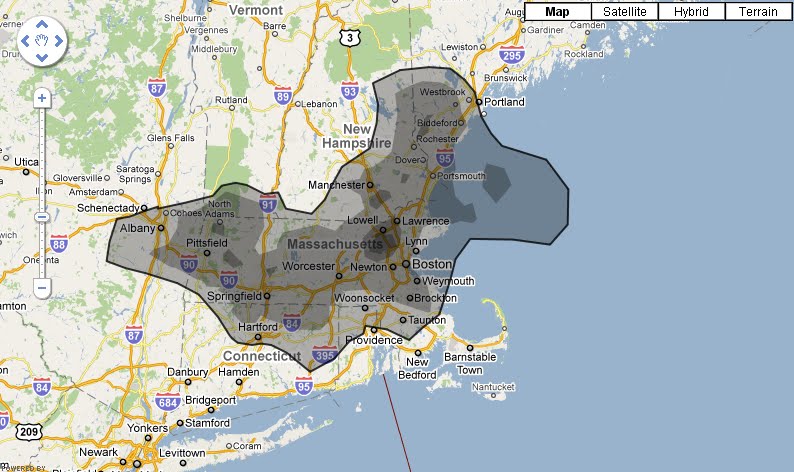
Try it yourself at:
http://www.ifitwasmyhome.com/
http://www.ifitwasmyhome.com/
Subscribe to:
Posts (Atom)