Tuesday, November 9, 2010

Not much of a change - part II

One thing about the mid-term elections that I am happy about is the election of Rand Paul as senator of Kentucky. Good job Rand, my hearty congratulations to you. Sen Elect Paul understands economics and has a good chance of affecting positive change. The rest of the re energized republicans and tea partiers don't seem to have much promise.


It's only recently that I've been able to recognize why the tea party movement doesn't move me. It's because although they say the right things much of the time, they suffer from the same problem that pervades politics: debating the merit of intentions instead of outcomes. They know what they want but have no idea how to get their because they don't understand economics, cause and effect, and the nature of mankind.


I have to think that the Obama administration has the best of intentions. So do the Republicans. So do the independents. I'll be darned, it looks like everyone has good intentions but we're still getting bad results. What we should be talking about is what is possible and correct within the context of economics.
No one seems to believe that debts have to be repaid. We pay lip service to it but it's always with this attitude that "someday" will never come or if it does it will be someone else's problem. Perhaps so, we might be able to kick the can down the road far enough that we'll all be dead and gone before we have to pay the piper. If if it isn't profoundly obvious that this attitude is grossly immoral then I don't know what to tell you. I not only see it as immoral but believe that the piper will have to be paid much sooner, in my lifetime.
I believe that "stimulating the economy" in the sense of getting things going by spending borrowed money is a fallacy. It doesn't improve our situation at all. It only delays the present danger we're facing. The only way an economy can be stimulated is by production; producing real goods and services. In our debates and discussions we have come to substitute money for productivity. Money is only a means of accounting for productivity (goods and services).
No matter how you look at it bad debt has to be borne out by society. The most efficient means to account for bad debt is through bankruptcy and other existing financial tools. The repercussions of bad debt are contained as narrowly as possible, by distributing the burden of debt to the lenders (the folks who signed up for the risk of lending money in the first place). Otherwise moral hazard compounds the problem and makes it more likely to happen again, and the people who can least bear the burden end up carrying it. In other words, let banks fail. Let the automotive industry fail. Let any business fail that isn't producing adequately. Our business climate will allow the assets and talent to quickly reorganize and start producing again while the worthless elements get eliminated.


This shouldn't be a discussion of what people deserve and what they should have. This should be a discussion that accepts the reality that economics is a natural science. We can't violate it's laws anymore than we can demand that gravity doesn't affect some people. What goes up will come down and in this case, no matter how high you throw the debt, it will come back down on your head.

Monday, October 11, 2010

Not as smart as you think - Medical Edition


It should come as no surprise to anyone to learn that corporations employ manipulation, half-truths, and outright lies to gain market share and increase revenue. We learn quickly in life to be wary of unscrupulous sales people. This article strikes a nerve though. Why does this bother me so much? Not because I'm surprised by it. Quite the contrary, I know this happens all too often, but it bothers me still the same because it takes advantage of a fundamental human flaw in how we reason. Not only is it manipulative, it does so with reckless disregard for one of the most vulnerable, significant aspect of life: our health and well being. It also stands as a warning to all of us, to reflect on why we make the choices we do and to question our rationale constantly.

Wednesday, August 11, 2010

Sad but true

I can't believe that "Idiocracy" is not just a stupid movie, it's the sad but true tale of what is really happening in America. I can't believe this is the way the story ends. We value illusion and form over substance and reality. The American electorate is truly Obama's dream come true. If we elected leaders based on principles, capability, and integrity he wouldn't have had a chance but he knows that in 2012 he can depend upon the gullibility of the masses who believe his grand illusions of hope and change. Two days ago Obama told a crowd in Austin "I'm pretty good at politicking". Obama's proudest trait is his ability to make empty promises.

Monday, August 9, 2010

Not as smart as you think

I have a habit of thinking about objectivity vs subjectivity and the frailties of the human mind. It is both frustrating and fascinating to see how profoundly irrational we all are. David McRaney has done us a huge favor by cataloging and explaining some of the most well known misconceptions about human thinking.

Monday, July 26, 2010

Making breaking the law against the law

My favorite quote from this Reuters article: "The law...makes being an illegal immigrant a state crime". Uh, yes, by definition.
This is what happens when we get so wrapped up in doublespeak that we forget the original meanings of words and phrases.

Friday, July 23, 2010

What's the harm in reducing carbon emissions?

Lately I've heard several arguments along the lines of "hey we can't be sure that global warming is real and we've grown tired of debating it. Let's just reduce carbon emissions anyway. There's no harm in that, right?" Well, actually there is. You see, everything we do has consequences. Allocating our resources into preventing carbon emissions does have a downside by limiting whatever could have been done with those resources.
Ideas like cap and trade, carbon credits, and laws against using carbon-based energy have a tremendous economic effect. Every time we make a choice there is something we do and something we do not do. It is that second part that we like to ignore. Spending a dollar on cleaning up the environment may be the right choice but that means that dollar won't be spent on anything else like curing cancer or feeding the hungry. So you better be certain that spending the dollar on "fixing" the environment is really fixing it. If not you just did something bad, by not doing good (and instead wasting resources). Whether spending resources on reducing carbon emissions is worth it lies with whether global warming exists and whether that is the solution. So, you can't escape the debate. Saying "what's the harm?" isn't a rhetorical question.

Wednesday, June 2, 2010

Just how big is the oil spill?

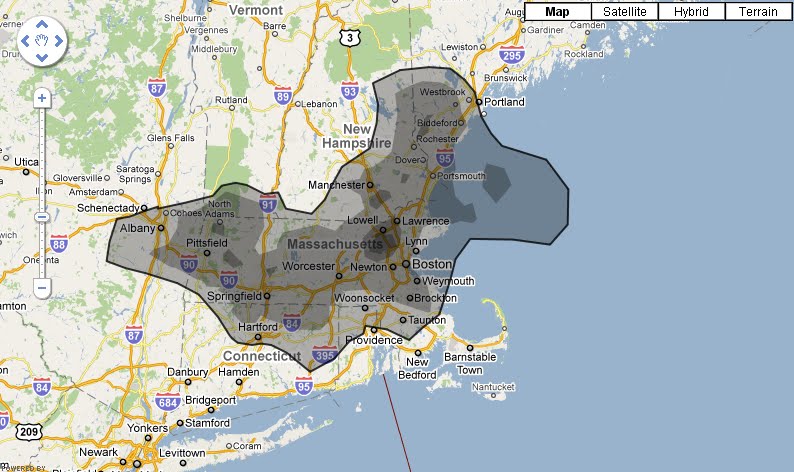
To give you an idea of how big the BP oil spill is, see how it would look if it were centered around my house near Boston:


Try it yourself at:
http://www.ifitwasmyhome.com/