My favorite quote from this Reuters article: "The law...makes being an illegal immigrant a state crime". Uh, yes, by definition.
This is what happens when we get so wrapped up in doublespeak that we forget the original meanings of words and phrases.
Monday, July 26, 2010


Friday, July 23, 2010
What's the harm in reducing carbon emissions?
Lately I've heard several arguments along the lines of "hey we can't be sure that global warming is real and we've grown tired of debating it. Let's just reduce carbon emissions anyway. There's no harm in that, right?" Well, actually there is. You see, everything we do has consequences. Allocating our resources into preventing carbon emissions does have a downside by limiting whatever could have been done with those resources.
Ideas like cap and trade, carbon credits, and laws against using carbon-based energy have a tremendous economic effect. Every time we make a choice there is something we do and something we do not do. It is that second part that we like to ignore. Spending a dollar on cleaning up the environment may be the right choice but that means that dollar won't be spent on anything else like curing cancer or feeding the hungry. So you better be certain that spending the dollar on "fixing" the environment is really fixing it. If not you just did something bad, by not doing good (and instead wasting resources). Whether spending resources on reducing carbon emissions is worth it lies with whether global warming exists and whether that is the solution. So, you can't escape the debate. Saying "what's the harm?" isn't a rhetorical question.
Ideas like cap and trade, carbon credits, and laws against using carbon-based energy have a tremendous economic effect. Every time we make a choice there is something we do and something we do not do. It is that second part that we like to ignore. Spending a dollar on cleaning up the environment may be the right choice but that means that dollar won't be spent on anything else like curing cancer or feeding the hungry. So you better be certain that spending the dollar on "fixing" the environment is really fixing it. If not you just did something bad, by not doing good (and instead wasting resources). Whether spending resources on reducing carbon emissions is worth it lies with whether global warming exists and whether that is the solution. So, you can't escape the debate. Saying "what's the harm?" isn't a rhetorical question.
Wednesday, June 2, 2010
Just how big is the oil spill?
To give you an idea of how big the BP oil spill is, see how it would look if it were centered around my house near Boston:

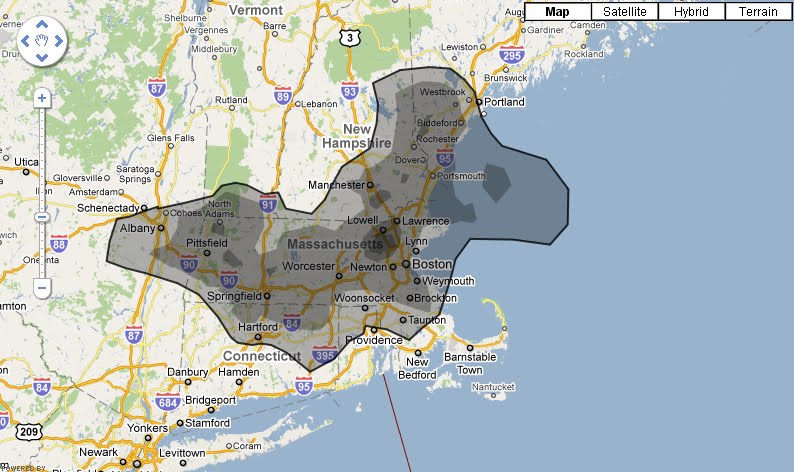
Try it yourself at:
http://www.ifitwasmyhome.com/
http://www.ifitwasmyhome.com/
Tuesday, February 16, 2010
Freedom for All
One of the fundamental tenets of what is often called liberalism is that freedom is a privilege not a right. Liberals suppose that freedom to choose is a privilege bestowed by society to those who prove themselves worthy of it. Only those who adhere to their point of view can be trusted to make decisions for their own lives and for others. Liberals would step into the role of vicarious parent to anyone whom they believe needs their guiding hand. While often motivated by the best of intentions, this attitude of "trust me, this is for your own good" coupled with the heavy hand of government has always led to tyranny and oppression.
So often those who are highly educated or wealthy believe that because they are intellectually superior they are necessarily morally superior.
Opposite of this viewpoint is the belief that freedom is essential to happiness and is an inalienable right so long as one does not infringe on the rights of others. It proposes that even if a person is uneducated, poor, or outside the status quo he or she retains the right to direct their life, preserve privacy, and have an equal voice in the community.
So what is a leader to do with those who don't share their point of view? By teaching fundamentally true principles in a way that entices others to follow it. Truth has a way of resonating with people and is perhaps the most powerful tool that a leader has.
Monday, February 15, 2010
Are You An Extreemist?
What if I asked another question, "Are you a leader"? In many ways those two questions overlap. The difference often lies in the subject matter. One might consider Genghis Khan or Joseph Stalin as extremists but what about George Washington, Jesus Christ, or Mother Teresa? Did anyone in their life caution them that they were getting a little too extreme? A little on the fringe? People seem to have an innate tenancy to seek safety in the the group. We are herd animals in some ways, which as civilized people manifests itself in philosophical gathering rather than physical flocking together. We find safety in the status quo.
In many ways “conventional wisdom” is an efficient way of sharing common knowledge and tips for living but often it can cripple us by limiting our true potential. We behave like sheep where the group dictates individual behavior, each member acting based on the movement/response of the whole. If you’re a sheep this is actually a good thing because sheep have a pretty limited mental capacity. Alone they can’t make it against a lion or wolf and so they depend on the herd’s behavior to determine when to run, when to eat, and when and where to march. In humans this is manifest in “group think” and peer-pressure. It is very difficult to do something or believe something when your peers do not believe the same way. We do it as a survival mechanism. Although we like to think that we are objective thinkers, somewhere in our subconscious mind we realize how foolish we are and so we tend to doubt our reasoning and intuition. We doubt that we can make the right decisions by ourselves and so we rely on peer-pressure to “course correct” us as we go.
If you are to become a leader you cannot rely solely on others to guide you. When all is said and done, the most important voice you should listen to is that still small voice inside of you called your conscience. There is nothing else you can rely on. If you do, you will find yourself ashamed of who you have become, or more appropriately, who you have not become, yourself.
In my experience, here are some of the top traits that I believe are necessary to be a leader:
1. Immunity to peer pressure. This is by far the most important. People who are worried about peer acceptance more than their inner voice rarely become leaders.
2. Competence. Not brilliance, but understanding your job well enough to get it done. This is much more rare than it might seem. Many people only know enough to get by and don't really understand all the factors that contribute to their role.
3. Responsiveness, lack of procrastination, and an ability to make decisions with confidence.
4. Ability to just get things done. Patience, focus, and ability to keep things moving forward.
5. Passion for your role. You have to really believe in what you do. You have to have an inner drive that pushes you relentlessly.
Saturday, January 23, 2010
The faster they rise, the harder they fall
As many one hit wonders could attest, it's hard to live up to a meteoric rise to the top. Too often celebrities find it hard to live up to the unrealistically high expectations of their fans. Right now Scott Brown is on top of the world, not unlike Mr. Obama a year ago. Maybe he should write a book right now, called "how I ruled the world (for one week)". I guess my point is that he needs to position himself to lead by the things he accomplishes and does and try to muffle the fan club until he has some track record in the senate. Right now he's just famous for being famous, sort of like the the mobius loop of fame Paris Hilton.
Wednesday, January 20, 2010
On Voting and Change
Last night Republican Scott Brown defeated Democrat Martha Coakley in what many consider the most significant political upset in recent history. Independent and Republican voters are euphoric today at the ramifications. I share partly in this joy because I think it sends a clear message to politicians that the mode of operation over the past year, and before, is unacceptable. We take a lot from politicians and often times let them get away with far too much but the spirit of liberty was manifest in the voice of the Massachusetts voters last night. However, I fear that what many see as a positive change may only be a change. It is not enough to say "not this way", we must find the best way. We have to really understand what liberty means and how it is achieved instead of trying any plan that promises change and then waiting to see if it works.
Only time will tell what kind of leader Scott Brown is though. I fear that we vote too often against a candidate or policy. Brown's win was more a referendum on the president and the Democrats and a vote of "No" against Martha Coakley than it was a vote of confidence in Scott Brown. When we can move beyond a contest of two parties and vote for the better of two candidates (rather than the lesser of two evils) then we will truly have our voice.
Only time will tell what kind of leader Scott Brown is though. I fear that we vote too often against a candidate or policy. Brown's win was more a referendum on the president and the Democrats and a vote of "No" against Martha Coakley than it was a vote of confidence in Scott Brown. When we can move beyond a contest of two parties and vote for the better of two candidates (rather than the lesser of two evils) then we will truly have our voice.
Subscribe to:
Posts (Atom)